

We bought a heritage workers cottage in Bronte in late 2025. Victorian Classical, part of a row of ten, built somewhere around 1878 to 1880. Tiny. Roughly 80 square metres of site area, which makes it the smallest lot in Bronte. We knew that going in. What we didn't know was what we'd find underneath it.
Move-In Day Surprise
"Brae" is a Scottish word for hill. Our cottage sits right at the tail end of one, and on move-in day we discovered what that actually means: opening a hatch in the kitchen floor we discovered a massive undercroft beneath the house. The space was dark and damp, but it was also full of potential. Andre took one look at it and said, "We're building down here."
That moment is basically how every good architecture project starts. You find something unexpected, and instead of fighting it, you design around it.
The Terrarium Concept
Here's the thing about basements. They're dark. They can feel like afterthoughts, tacked on for storage or laundry and never really loved. We didn't want that.
Andre came up with a terrarium light well concept for the basement level. Picture a vertical garden encased in glass, pulling natural light deep into the lower floor while creating this living, breathing green element right in the middle of the house. It turns what would normally be the worst room in the house into the most interesting one.
The basement will house utilities, but the terrarium makes it feel nothing like a basement. It's the heart of the design, honestly. The whole project grew outward from that one idea.
Designing on 80 Square Metres
When your site is this small, every square metre matters. There's no room for hallways that don't earn their keep or spaces that only serve one purpose.
The design stacks the house vertically across three levels. A new first floor addition sits above the existing cottage footprint, housing the bedrooms. The ground floor opens up into living, dining and kitchen. And the basement, carved into the hillside, becomes a space anchored by the terrarium light well. It sounds simple when you lay it out like that. It was not simple.
The Council Chapter
Our total floor space ratio landed at 1.26:1, which exceeds the standard controls for the area. On a normal-sized block, that would be a hard sell. But when your entire site is 83 square metres, the standard ratios don't quite account for how constrained everything is. We lodged a Clause 4.6 variation arguing exactly that: the numbers look high because the site is genuinely tiny, not because the building is oversized.
Council's first response was to defer the application. Their main concern was buildability. Could we actually excavate and construct a basement on a site this tight? Fair question.
The original design called for about 65 cubic metres of excavation. After working through the deferral with our town planner Scott Lockrey, we came back with a compromise: basement excavation reduced to 30 cubic metres, roughly a 53 per cent reduction. Same concept, tighter footprint. It addressed council's concerns without gutting the design.
The whole DA process took about six months from lodgement to approval. The DA was approved at a council meeting, which felt like a milestone worth celebrating.
Why We're Sharing This?
Architects don't usually talk about their own homes. There's an unspoken rule that the cobbler's children go barefoot, that you pour everything into client work and your own place stays half-finished forever.
We're doing the opposite. The Brae is a real project on a real (very small) site with real council constraints, and we want to document the whole journey. The wins, the compromises, the moments where you stare at a floor plan at midnight wondering if you can shave 200mm off a hallway.
If you're thinking about renovating a heritage home in Sydney, especially on a tight site, this is what the process actually looks like. It's not glamorous. It's six months of drawings, reports, meetings and emails. But when you get that approval letter, it's worth every revision.
What's Next
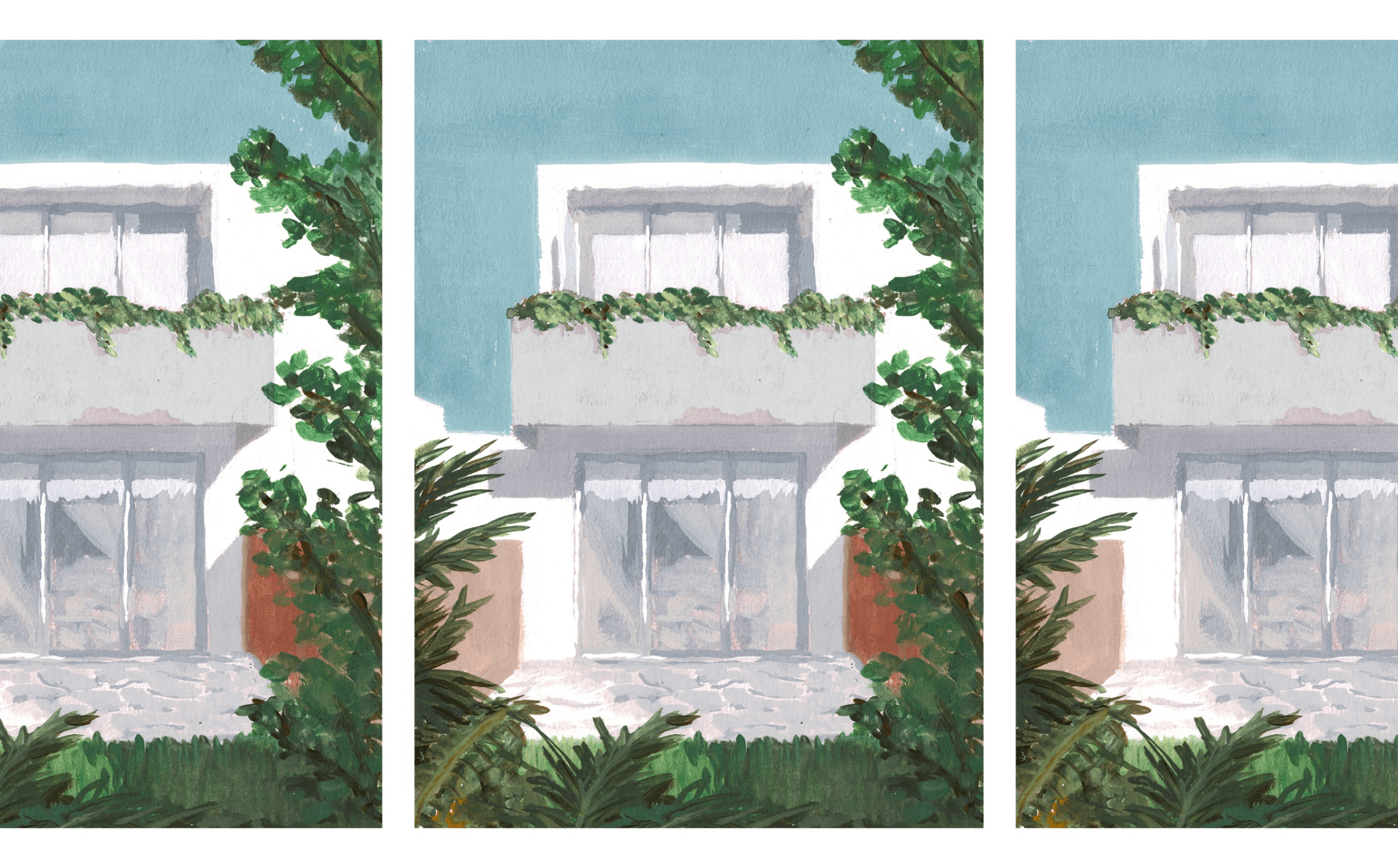
Now the fun part starts. We're moving into interior design, then tender and construction. Andre has already done a painting of the project (because of course he has), and we'll be sharing progress as The Brae comes to life.
The terrarium is going to be spectacular. We'll make sure you see it.
Header image: Andre's painting of The Brae. Place at the top of the article as the hero/cover image.
The Brae is Studio Frino's own heritage renovation in Sydney's Eastern Suburbs. Town planning by Scott Lockrey.
.jpeg)
